OpenAI Acquiring Astral: A 4th Option for Funding Open Source
If you are a programmer and especially if you work with the Python programming language, today’s news that OpenAI (the makers of ChatGPT) acquired Astral is a big deal. Both OpenAI and Astral put out blog posts announcing the deal.
Python is at the forefront of modern AI development and Python tooling–the boring but hard and essential parts of making the workflow around the language better–is Astral’s forte. In a few short years, Astral introduced three open source projects–ruff, uv, and ty–that are now widely used and relied upon in the Python ecosystem.
Their acquisition leads to mixed feelings amongst many in the Python community. Happy for the team given all their efforts to advance the language and tooling, but with justifiable concern about what comes next now that they are under the umbrella of a for-profit company.
Why should you care? Well, as ever, xkcd has us covered.
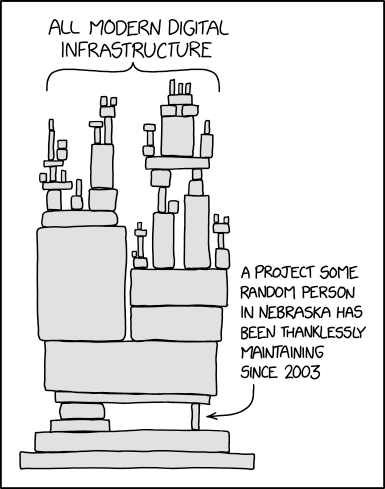
In a world of billion-dollar startups and trillion-dollar public tech companies, an unreasonable amount of software that underpins it all is open-source (meaning free to use) and maintained by a person or a small group of people paid little or nothing to do it.
Side note, JetBrains, where I now work, is a meaningful exception to this. They have long been the single largest contributor to the Django web framework and support open source work broadly across the Python and broader programming ecosystem. But this is rare.
How to Fund Open Source
Maintaining open source is a long-standing issue in software development. Nadia Eghbal has an excellent book on the topic, Working in Public, if you’d like a more detailed exploration.
But essentially, there have historically been three ways to fund open source work:
- Solo Developer: someone who creates a project and finds a way to keep working on it, usually through consulting or premium paid products
- Non-Profit Organization: this is the approach of Django and Python itself, a community that supports and runs the project
- Corporate Overlord: an open source project escapes from the corporate labs and is made available
VC + Open Source
Astral pioneered a fourth approach, which was to accept Venture Capital investment. With this money, Astral was able to hire and pay world-class engineers to work on open source projects, delaying the need to make an immediate profit.
We’ve seen other well-known projects adopt this playbook as well; both Laravel and FastAPI, have accepted VC funding for hosting products.
What Comes Next?
This is the open question: no one really knows. Open source projects with external funding are able to move fast, hire teams, and innovate at a pace unavailable to solo or community-led efforts. The flip side is that those efforts are maintainable over the long run. The goal is not to raise millions of dollars, but rather to make enough to continue the work.
That’s the fundamental tension. An open source project like Django, which I’m intimately familiar with, looks over at all the funding from this fourth option and wonders how much faster the project could advance. At the same time, Django (and Python itself) are not run by an individual or a company, but by a community that may move slowly but is ultimately incredibly resilient. Django just celebrated its twenty-year anniversary. Will any of these VC-funded open source projects be able to say the same?